Illustration for this trekking conditions guide.
Avoid getting lost on a group trek by agreeing how the group moves, how to report stops and how to contact the responsible person. If you are unsure of the route or cannot see the group, do not choose a turn by guesswork just to catch up.
Learn the group procedure before walking
Ask who leads, who coordinates people behind and how the group checks participants at stops. Discuss photograph breaks and what to do if you need to stop independently.
Save contact and trip information, while recognising that mobile reception can be absent. The communication plan needs more than access to a group chat.
Follow the route requirements for Khang Su Van or Po Ma Lung. A downloaded track does not authorise changing the agreed path.
Notice habits that separate people
Moving quickly at a junction, stopping without telling anyone, concentrating on a photograph or taking an apparent shortcut can create an information gap. Clarify the procedure instead of relying only on another device.
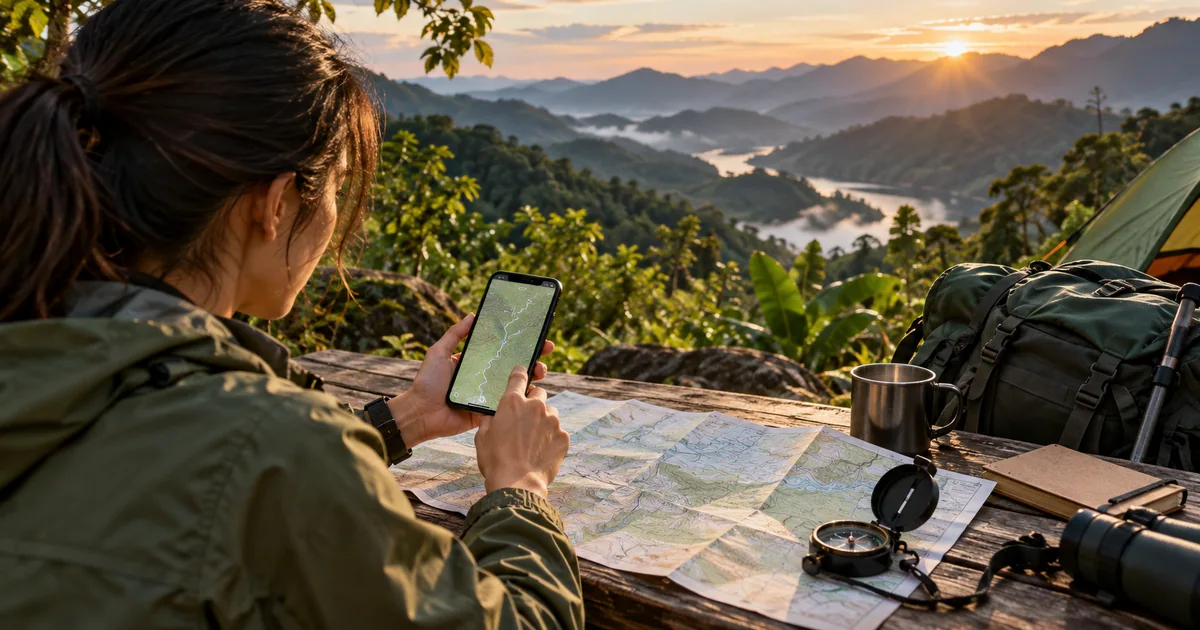
An offline map can show prepared data. It does not assess the route today or communicate your situation to the leader.
If you are no longer sure of the direction
Avoid adding distance based on an unconfirmed assumption. Reassess from an appropriate position and try the agreed method of contacting the responsible person.
Do not turn the situation into an improvised new route through the forest, along a watercourse or over a shortcut. This article cannot assess your surroundings remotely or provide a universal self-rescue procedure. Immediate danger requires appropriate local support and attention to your actual situation.
| Information | Useful description when contact is possible |
|---|---|
| Identity | Your name and departure |
| Last certain point | A place or event you remember, labelled separately from a guess |
| Time | When you last saw the group and noticed uncertainty |
| Position | Available coordinates or a screenshot, with any uncertainty explained |
| Situation | Who is with you and any health or equipment problem |
| Contact | Battery, reception and how to reach you again |
Send necessary information to the responsible contact rather than publicly sharing sensitive details when an established response is available.
Understand equipment limits
Keep light, power, rainwear and essentials accessible. A phone you cannot retrieve from supported luggage cannot help you report a concern during the stage.
An SOS button or website feature depends on the actual service, connection, permissions and response process. It is not a promise that rescue is always available. Ask how it works for your trip; do not send a false emergency request to test it.
Does GPS make getting lost impossible?
No. Data, position accuracy, battery and interpretation all have limits. Use the pre-departure checks and follow the group procedure.
Read changing weather conditions alongside group pacing.
For general preparation and staying within your abilities, see NPS Hike Smart guidance.