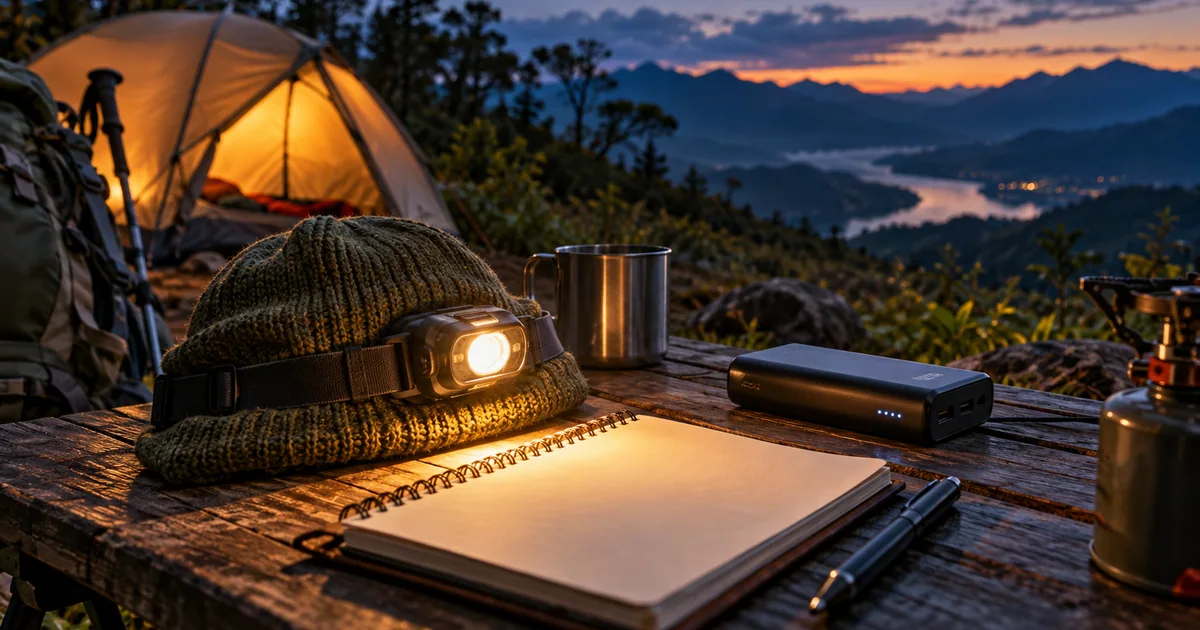
Illustration for this trekking equipment guide.
Choose a hiking headlamp by the task, beam, power supply and fit, as well as brightness. A headlamp provides light while leaving your hands free. Test the controls and batteries before the trek, including when the organiser supplies the equipment.
Why plan beyond your phone’s torch?
Your phone also serves communication and trip information. Holding it for light occupies a hand and consumes power you may need for other functions.
A headlamp still needs correct adjustment and appropriate use. It does not justify moving away from the group’s plan after dark. Keep the beam out of other people’s eyes.
| Feature | Question |
|---|---|
| Beam | Is it intended for close tasks, the trail ahead or both? |
| Output and modes | Can you select a suitable level easily? |
| Power | Replaceable batteries or charging, and which type or cable? |
| Runtime | At which setting and under which test conditions? |
| Fit | Is it stable with the hat you will use? |
| Wet conditions | What are the protection limits of the exact model? |
Try the light when receiving it
Turn it on, change modes and adjust the angle. If it has a lock against accidental activation, learn that before placing it in the bag.
Check the battery type, charging connection and power condition. Do not assume all rechargeable lights use the same connector or that a power bank has enough remaining charge for every device.
A high maximum output does not mean the lamp maintains that output for its entire advertised runtime. Read the instructions for the model rather than turning a lumen figure into an assumed number of hours.
Match the plan to the dark stages
A programme may include a summit start before dawn and evening use at the hut. Read Day 0 and the later stages separately to know when the light must be accessible.
If the tour supplies a lamp, confirm when it is handed over. For Khang Su Van or another multi-day programme, ask about the power plan across the whole trip and what to do if equipment fails.
Store it accessibly and use it considerately
Keep the lamp somewhere you can reach without unpacking bedding in the dark. Protect it from moisture within its stated limits and prevent accidental activation during transport.
At the hut, use a suitable setting and direction. Avoid shining towards people who are resting. The same equipment has different tasks on the trail and in shared accommodation.
Is the brightest light automatically the best?
Beam pattern, power, controls and the route also matter. More output alone does not establish that a model fits your needs.
Should I take my own if one is supplied?
Confirm the service and your personal requirements. Read equipment choices and the checklist before duplicating kit.
REI distinguishes light output from beam distance and explains why runtime settings matter. See REI’s headlamp guide.